Community Psychedelic Care: Beyond the "Expert" Model
Why are pathways to working with plant medicine limited to only therapists, doctors, and clinicians?

I know I have made others within the psychedelic “professional” field uncomfortable because I don’t have a license and I’m not a registered counsellor or therapist. There has been massive assumptions about the level of care I provide as someone working purposefully outside the medical system. There have been doubts about my education within this space because I lack clinical credentials. Instead of questioning my exact lived experience, my cultural lineage, my training, or my thousands of hours of trauma-informed facilitation… there are larger questions to ask here:
In the emerging landscape of psychedelic care, we stand at a crucial crossroads. As these powerful medicines re-enter mainstream consciousness, we have a profound responsibility to ask: whose wisdom are we centering? Whose voices get to shape this movement? And how do we avoid recreating the same colonial patterns that have harmed marginalised communities for centuries?
Challenging the Expert Paradigm
For the last hundred years, the Western approach to psychedelic care has operated on a hierarchical model where “experts” (typically white, male, educated, clinically trained individuals) hold the keys to healing. This perspective reproduces the same power dynamics that have positioned plant medicine as something to be extracted, controlled, and monetised rather than something to be shared, honoured, and collectively stewarded.
But what if we approached psychedelic care differently? Can we recognise that expertise takes many forms - not just academic degrees, but lived experience, cultural lineage, intuitive knowing, and the wisdom that emerges from authentic human connection? Can we trust the community network to provide care for family, friends, and neighbours with integrity beyond the clinical or legal system?

Community-Centered, Peer-Led Care
I created Fundamentals of Psychedelic Care as gateway training with a radical premise: the people with lived experience have the potential for the deepest wisdom about healing. This is why we centre community-led, peer-supported models that:
Honour lived experience: Those who have journeyed through darkness often carry the brightest light. Their direct experience has the potential to create grounded and anchored support for others.
Center harm reduction: Before rushing toward therapeutic outcomes, we prioritise safety, autonomy, and informed consent. We begin with the question “How can we ensure this experience honours your wellbeing?”
Embrace diverse pathways: Healing isn’t linear, and neither is expertise. We validate cultural knowledge that predates Western psychology, intuitive gifts that defy scientific measurement, and the wisdom that emerges from authentic human connection and presence. While we weave in modern developments on nervous system regulation, somatic care, and psychedelic research.
The Sacred vs. The Clinical
We must acknowledge painful truths from psychedelic history: MK Ultra’s unethical LSD experiments, Maria Sabina’s cultural extraction, the War on Drugs, the pharmaceutical industry’s attempts to strip away the sacred from plant medicines, and the ongoing cultural appropriation of Indigenous practices. These weren’t just mistakes - they were the predictable outcomes of “taking over” plant medicine rather than “taking care.”
A community-powered perspective of care is about being in relationship. Something ancient cultures have known for far longer than western societies. So how might we return to these ways of beings? Perhaps:
The understanding that these medicines are teachers and allies, not tools
The recognition that healing happens in community, not in isolation
The wisdom that presence matters more than technique
The humility to learn from those who have walked these paths for generations
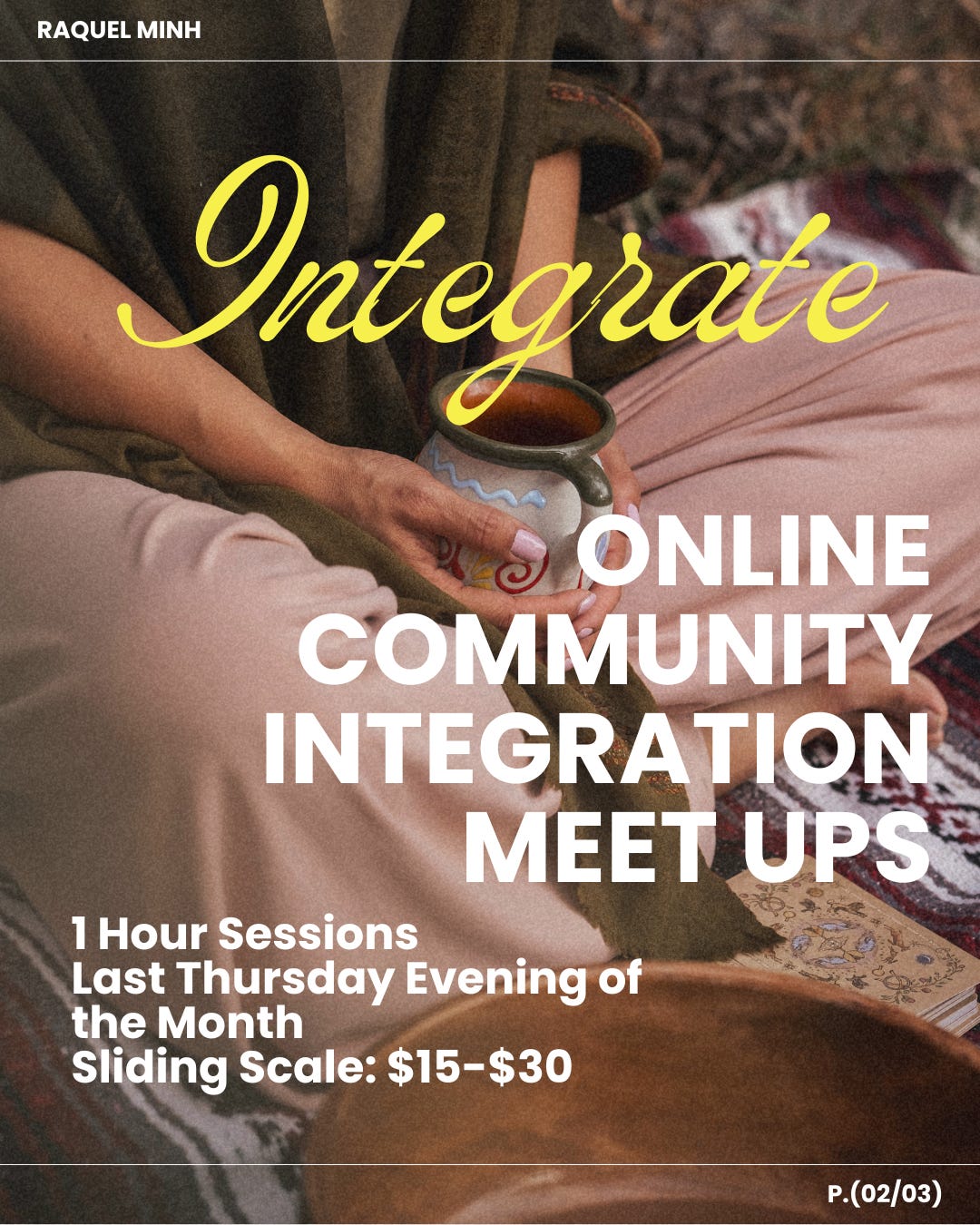
Our online monthly community psychedelic integration meet ups provide a collaborative space to share your stories from altered states. Witness others’ share vulnerably while you practice active listening and being an anchor of support. We bring voices from across many fields to share integration frameworks to expand meaning from your journey.
Creating New Systems of Integrity
Currently, psychedelic care is being decided for us by governments prioritising capitalism, hierarchy, and lack of lived experience (if more world leaders would go on an acid trip… how different could our geo-political systems be…) Many doctors and therapists who believe in this work, feel scared to promote it due to risk of stigma or losing their licenses.
Now is the time to be bold and contribute towards a psychedelic care system based on reciprocity rather than extraction, on relationship rather than hierarchy, and asking:
Whose land are we on as we work with these medicines?
Whose knowledge are we building upon?
How do we ensure benefits flow back to communities?
How do we create networks of mutual support rather than competition?
This isn’t about rejecting clinical training - it’s about expanding our definition of expertise. It’s about creating space for the grandmother who holds ancestral knowledge, for the peer support worker who understands addiction from lived experience, for the ceremonialist who honours traditional protocols, and for the clinician who bridges scientific and spiritual understanding. It’s important to challenge the legal framework, when it’s not serving our most vulnerable or the greater good.
There’s a fear of renegade cowboy shamans creating unhealthy and unsafe containers. Fair. There’s risk that inexperienced tripsitters will not honour their scope of practice. Very possible. So how can we ensure we’re also creating safety mechanisms outside the legal framework? Well, people have been working with plant medicines for a very long time… so I trust we can navigate this together. And it begins by starting the conversation.
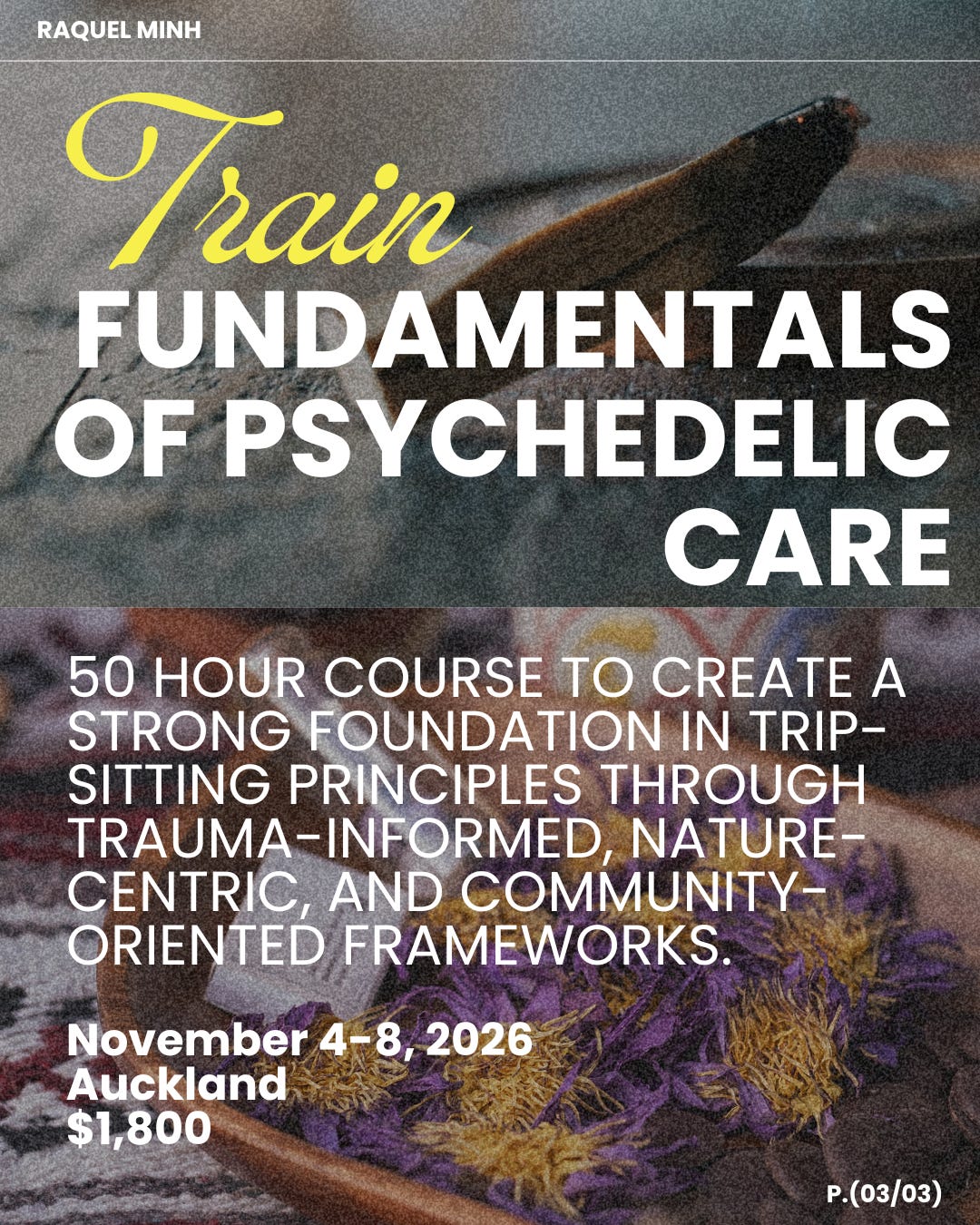
Fundamentals of Psychedelic Care is here for those who resonate with this message. In this course, you’ll enhance your ability to be present with others in non-ordinary states while honouring your scope of practice. Get clearer on your role within community and the network available to you to support yourself and others. Draw from clinical and medical frameworks to understand screening, contraindications, dosage, trauma responses, and emergency support plans. This is a gateway training that will inspire your path towards academia/research, therapy or counselling, policy or advocacy, or a return to your ancestral ways.
Dreaming Into Reality
Imagine a world where psychedelic care is:
Accessible to those who need it most, not just those who can afford it
Rooted in cultural humility rather than cultural appropriation
Led by those with lived experience rather than by those with the most credentials
Focused on collective healing rather than individual outcomes
Grounded in reciprocity with the plants and the communities that have protected them
This is the world we’re working to create - one relationship, one community, one act of decolonisation at a time. The path forward requires courage, humility, and a willingness to unlearn what we think we know about expertise and healing.
As we stand at this threshold, let us choose a way forward that honours the sacred, respects the wisdom of many traditions, and centres the voices that have been too long silenced. The medicines are calling us to something deeper - will we answer with open hearts and willing spirits?
Learn more Fundamentals of Psychedelic Care with School of Modern Meditation | 50 Hour Course in November 2026. Sliding payment scale.
Join the next online Monthly Community Psychedelic Integration Meet up | Last Thursday evening, 7:30PM NZT.